
23.07.2025
Machine Learning w praktyce – jak algorytmy zmienią Twoje biznesowe decyzje
Key information:
- Machine learning (machine learning. Machine Learning) to obecnie jedno z najważniejszych narzędzi technologicznych, które pozwala firmom optymalizować działania, przewidywać trendy i podejmować trafniejsze decyzje na podstawie danych.
- W połączeniu ze sztuczną inteligencją umożliwia automatyzację procesów, personalizację obsługi klienta oraz analizę danych w czasie rzeczywistym.
- Zastosowania obejmują m.in. analizę zachowań konsumenckich, rozwój produktów, diagnostykę medyczną, wykrywanie oszustw i predykcję sprzedaży.
- Wdrażając takie systemy, firmy muszą brać pod uwagę nie tylko efektywność, ale również kwestie zgodności z regulacjami – szczególnie z AI Act i RODO, które regulują wykorzystanie sztucznej inteligencji.
Details below!

W ciągu ostatnich kilku lat Machine Learning stał się kluczowym elementem transformacji cyfrowej w organizacjach. Firmy każdego dnia generują ogromne ilości danych – od kliknięć użytkowników, przez dane sprzedażowe, po wyniki badań medycznych. Przekształcenie tych informacji w realną wartość biznesową wymaga nowoczesnych narzędzi analitycznych.
Algorytmy uczenia maszynowego potrafią analizować dane szybciej i trafniej niż człowiek, dostrzegając powtarzalne wzorce, zależności i anomalie. Dzięki temu możliwe jest tworzenie systemów rekomendacyjnych, dynamiczna optymalizacja cen, czy automatyczne podejmowanie decyzji operacyjnych. It is Machine Learning wykorzystany w analizie danych pozwala na lepsze zrozumienie klientów i szybsze reagowanie na zmieniające się warunki rynkowe.
Warto jednak pamiętać, że rozwój uczenia maszynowego i sztucznej inteligencji wiąże się z odpowiedzialnością. Nowe przepisy prawne, w tym regulacje AI (np. AI Act), nakładają na firmy obowiązek dbania o transparentność, bezpieczeństwo i zgodność z zasadami etyki.
What is Machine Learning?
Artificial intelligence, a zwłaszcza Machine Learning, pozwala komputerom działać „na własną rękę”. Zamiast programować każdą regułę, wystarczy dać im dane – a system sam nauczy się, co robić dalej. Modele ML wykorzystują dane treningowe, by „nauczyć się” rozpoznawania wzorców i podejmowania decyzji w nowych, nieznanych sytuacjach.
Basic approaches of Machine Learning
- Supervised learning - The model trains on labeled data (e.g., photo + label "cat").
- Unsupervised learning – system sam szuka grup lub struktur w danych (np. segmentacja klientów).
- Teaching through reinforcement – model „uczy się” poprzez system nagród i kar (np. gry strategiczne).
- Deep learning - An advanced form of ML using neural networks, used for image recognition, speech, and natural language processing, among others.
W praktyce uczenie maszynowe w biznesie to sposób na podejmowanie trafniejszych decyzji na podstawie danych. W obliczu rosnącej złożoności rynku i lawinowo przyrastających informacji klasyczne metody analizy nie wystarczają. Tu właśnie wchodzą do gry algorytmy w analizie danych, które potrafią „wyłowić” z nich to, co naprawdę istotne.
How does Machine Learning work?
Although Machine Learning (ML) is sometimes presented as an advanced technology, its operation is based on a few logical steps. Zrozumienie tego procesu jest kluczowe przy planowaniu wdrożeń w firmie, a także przy ocenie ryzyk związanych z jakością danych i zgodnością z regulacjami.
Krok 1 – Zbieranie i przygotowanie danych
The basis of any ML project is data. Companies use transactional, behavioral, medical or textual data. Their quality has a direct impact on the effectiveness of the model.
Etapy przygotowania danych obejmują czyszczenie, standaryzację, uzupełnianie braków i usuwanie duplikatów – i właśnie tu rozpoczyna się analityczne uczenie.
Step 2 - Algorithm selection
W zależności od zadania – klasyfikacja, regresja, klasteryzacja – stosuje się różne algorytmy uczenia maszynowego:
- decision trees - work well when you want to make decisions based on simple "yes/no," such as whether a customer will get a loan,
- logistic regression - used mainly to predict two possible outcomes, such as whether an e-mail is spam or not,
- neural networks - come in handy when the data is complex, such as recognizing faces in photos or forecasting the weather,
- heuristic algorithms - We use them where there is no single right answer, but we want to find the best possible solution, such as how best to plan a delivery route,
- deep machine learning (deep learning) – wykorzystywane do bardzo złożonych i trudnych zadań jak rozpoznawanie chorób lub analiza zdjęć medycznych, gdzie jest dużo danych.
Krok 3 – Trenowanie i testowanie modelu
Model „uczy się” na danych treningowych, a następnie jego skuteczność testuje się na danych, których wcześniej nie widział. To pozwala przewidzieć, jak poradzi sobie w rzeczywistych warunkach. To evaluate the effectiveness of learning systems, metrics such as accuracy, precision, and F1-score are used. Model accuracy is crucial, for example, in medical data analysis or fraud detection.
Krok 4 – Wdrożenie i monitorowanie
The finished artificial intelligence model can be connected to a CRM system, online store or customer service application. Jednak to jeszcze nie wszystko, ponieważ uczenie maszynowe w praktyce nie jest procesem jednorazowym. Modele ML trzeba stale monitorować i dostosowywać, bo dane się zmieniają – podobnie jak klienci i ich zachowania.
Zastosowania Machine Learning w biznesie
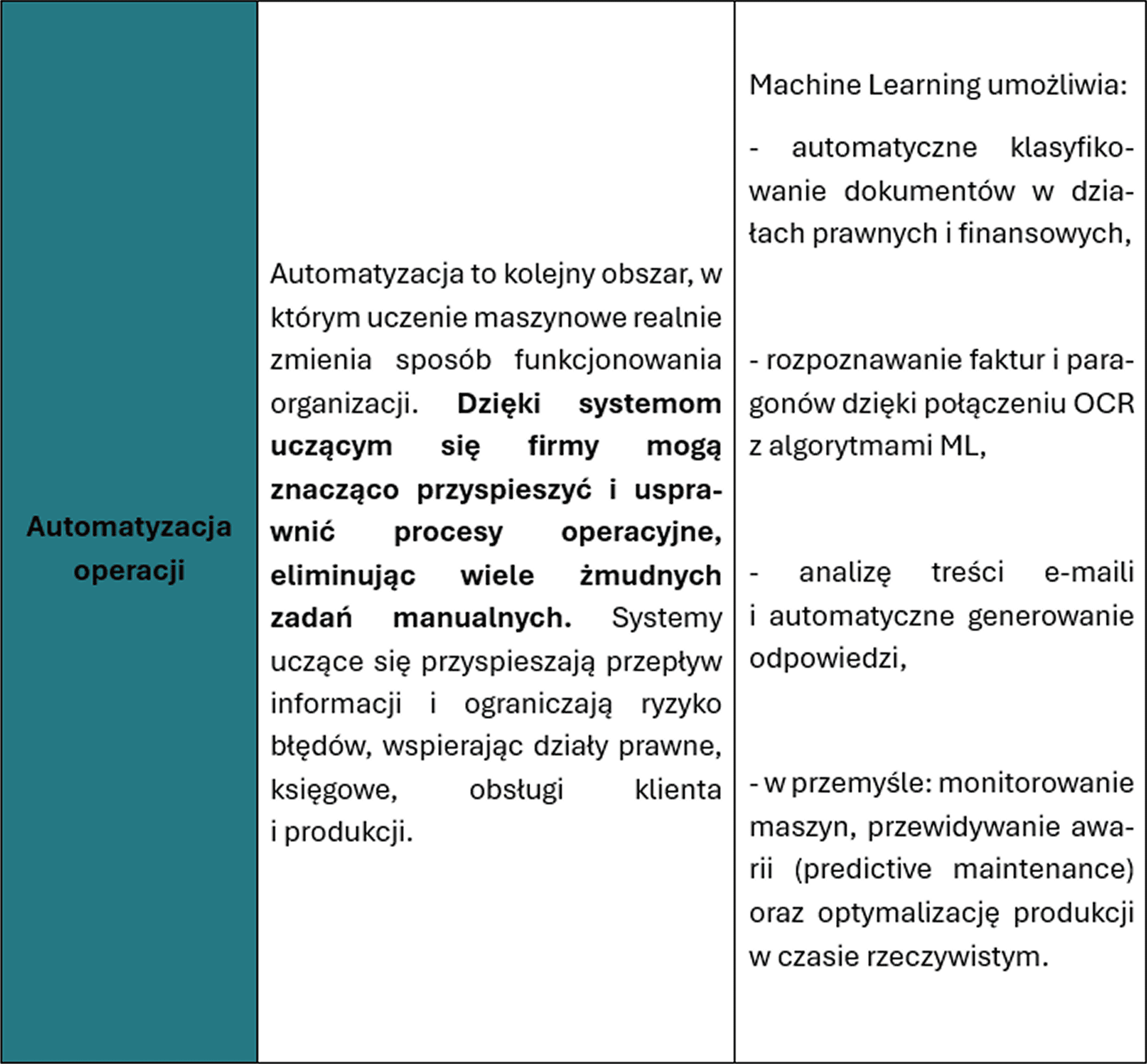
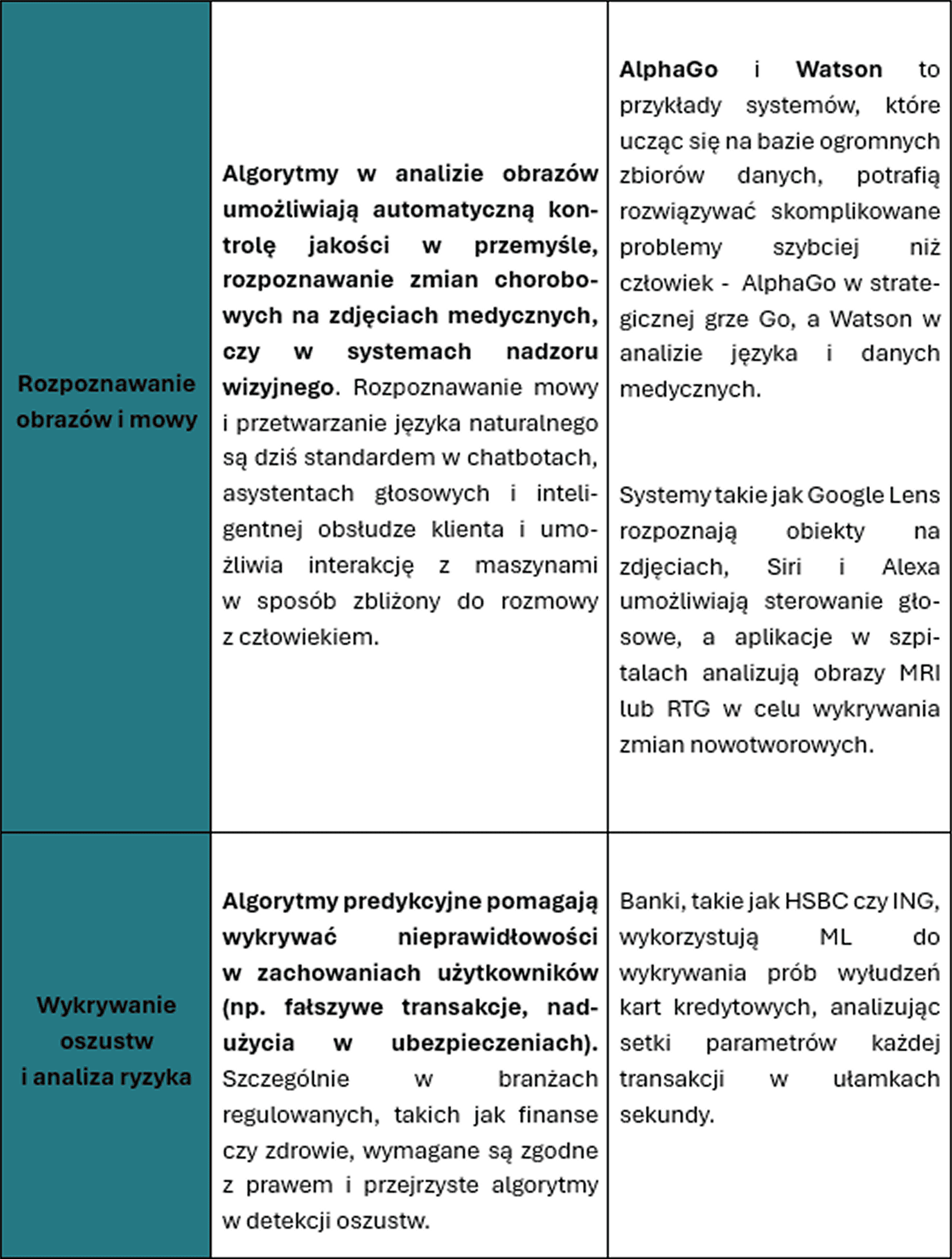
Sztuczna inteligencja w biznesie to dziś coś więcej niż modne hasło. Dzięki uczeniu maszynowemu firmy oszczędzają czas, podejmują trafniejsze decyzje i zwiększają przychody. Here are the most important areas of AI application:

Korzyści i wyzwania związane z wdrożeniem Machine Learning
Poniżej przedstawimy korzyści oraz wyzwania, które wynikają z wdrożenia Machine Learning do automatyzacji procesów w firmie.
Benefits
- Increase operational efficiency
Uczenie maszynowe w praktyce automatyzuje rutynowe procesy, zmniejsza liczbę błędów i pozwala szybciej przetwarzać dane. Przykładkładow, firmy produkcyjne korzystają z algorytmów w analizie danych jakości, by w czasie rzeczywistym wykrywać defekty i obniżać koszty.
- More accurate business decisions
Modele ML wspierają zarządzanie cenami, prognozowanie popytu, ocenę ryzyka i optymalizację działań marketingowych. Uczenie maszynowe w analizie danych trendów pozwala szybciej zauważać zmiany na rynku i reagować z wyprzedzeniem.
- Better personalization
Systemy oparte na ML potrafią dostarczać precyzyjne rekomendacje i dostosowywać komunikaty do profilu klienta. W rezultacie, występuje zwiększona konwersję, lojalność i przychody. W szczególności jest to istotne w branży e-commerce i usługach cyfrowych.
- Competitive advantage
Firmy wdrażające systemy uczące się i automatyczne systemy uczące się szybciej reagują na zmiany i skalują swoje operacje.
- Nowe produkty i usługi
Uczenie maszynowe w rozwoju rozwiązań pozwala szybciej testować prototypy, optymalizować iteracje i dostarczać produkty trafiające w rzeczywiste potrzeby rynku.
Challenges
- Data quality
Błędy, braki i niejednorodność danych mogą prowadzić do złych decyzji. Modele Machine Learning są tak dobre, jak dane, które je zasilają. Analityczne uczenie wymaga czasu, wysiłku i inwestycji w infrastrukturę danych.
- High technological requirements
Zaawansowane projekty ML potrzebują mocy obliczeniowej (np. GPU), skalowalnych środowisk chmurowych i ciągłego utrzymania.
- Lack of interpretability of models
Niektóre algorytmy – szczególnie w głębokim uczeniu maszynowym – są bardzo złożone i podejmują decyzje w sposób trudny do przeanalizowania. W sektorach regulowanych takich jak np. bankowość czy medycyna, gdzie ważna jest pełna przejrzystość i uzasadnienie decyzji, taka nieczytelność modeli może być istotnym ograniczeniem.
- Staff shortages
Brakuje specjalistów od Machine Learning, data science i inżynierii danych. To ogranicza tempo wdrażania i jakość projektów.
- Regulacje i odpowiedzialność
Nowe regulacje AI (np. AI Act) nakładają na firmy obowiązki dotyczące przejrzystości, ochrony prywatności, unikania dyskryminacji i audytowalności decyzji systemów AI.
Niezgodność z przepisami może oznaczać sankcje, szczególnie w systemach wysokiego ryzyka (np. analiza danych medycznych, scoring kredytowy).

Tips for companies planning to implement Machine Learning
- Set a clear business goal
Zidentyfikuj konkretny problem lub szansę. ML nie rozwiązuje wszystkiego – najlepiej działa w konkretnym kontekście: np. przewidywanie, klasyfikacja, segmentacja.
- Prepare data
Stwórz solidne repozytorium danych, dbając o ich jakość, zgodność z obowiązującymi regulacjami (w tym RODO) oraz regularną aktualizację. Dane to paliwo dla Machine Learningu – bez nich projekt nie zadziała.
- Start with a pilot
Testuj rozwiązania w małej skali, np. poprzez uczenie maszynowe w projektach komunikacyjnych, by ograniczyć ryzyko i zdobyć doświadczenie.
- Build an interdisciplinary team
They will need:
- Data Scientists,
- Machine Learning Engineers,
- Field experts,
- Osoby od zgodności z regulacjami AI i prawa technologii.
- Uwzględnij przepisy i etykę
Zadbaj o przejrzystość modeli, dokumentację, ochronę prywatności i mechanizmy kontroli wyników – to kluczowe dla zgodności z AI Act.
- Monitoruj i aktualizuj modele
The data environment is constantly changing, so a model implemented a year ago may generate erroneous results today. Sztuczna inteligencja może dawać przewagę, o ile nadąża za rzeczywistością. Models need to be checked regularly so that they continue to make accurate decisions.
How is Machine Learning changing decision making?
Machine learning is becoming not only an operational tool for companies, but also a strategic one. Dzięki sztucznej inteligencji firmy nie tylko analizują dane – one przewidują, co się wydarzy i podejmują działania, zanim konkurencja zdąży zareagować.
From data to decisions
Tradycyjne zarządzanie często opiera się na przeszłych raportach i założeniach. Uczenie maszynowe w analizie trendów eliminates this problem because:
- shows what is happening now,
- predicts what will happen next,
- suggests how best to respond.
Modele Machine Learning pomagają firmom planować kampanie, dostosowywać produkcję, przewidywać rotację klientów, a nawet oceniać skutki zmian strategii.
Segmentacja i personalizacja
Z pomocą algorytmów w analizie danych osobowych i zachowań, firmy mogą dokładniej segmentować klientów i automatycznie dostarczać spersonalizowane komunikaty, produkty czy oferty. To kluczowe np. w marketingu, bankowości, telekomunikacji, e-commerce.
Automation of operational decisions
Systemy uczące się wspierają automatyczne podejmowanie decyzji w obszarach takich jak:
- credit allocation,
- insurance risk assessment,
- supply chain management,
- price optimization.
Tego typu decyzje, jeszcze niedawno podejmowane ręcznie, są dziś wykonywane przez algorytmy w analizie strategii i dane behawioralne w czasie rzeczywistym.
Odpowiedzialność i regulacje
Increasing automation of decisions also brings with it responsibilities. Zgodnie z AI Act, organizacje muszą zapewnić:
- Transparency of model performance,
- The ability to explain decisions made (explainable AI),
- mechanizmy sprzeciwu i korekty.
Dlatego wdrażając Machine Learning, firmy muszą myśleć nie tylko o efektywności, ale także o zgodności z regulacjami AI i etycznym podejściu do automatyzacji.
Jeśli jeszcze nie inwestujesz w sztuczną inteligencję, pytanie nie brzmi „czy warto?”, ale „kiedy będzie za późno?”
Machine learning is no longer an experiment, but a viable tool to transform the way companies operate. Umożliwia szybsze, trafniejsze i bardziej przewidywalne decyzje – zarówno na poziomie operacyjnym, jak i strategicznym.
Jednocześnie, by w pełni wykorzystać jego potencjał, organizacje muszą zadbać o:
- data quality,
- The relevant competence of the team,
- zgodność z obowiązującymi przepisami i normami.
The future of business is based on data. A uczenie maszynowe i sztuczna inteligencja to technologie, które umożliwiają wydobycie z tych danych maksymalnej wartości.
Blazej Flis
See other entries

Wojna AI: OpenAI, Google, Meta i inni – kto wygra wyścig o dominację na rynku modeli językowych?
See more