
02.09.2026
Check out 9 questions every SME owner should know the answer to!
Artificial intelligence has ceased to be a technological novelty; today, it is genuinely changing customer expectations, price levels, and the structure of competition in almost every industry.
- In 2025, 8.7% Polish companies were using AI tools, compared to 5.9% the previous year, and among large companies, that percentage had already reached 42%.
- As many as one in six jobs in Poland is currently at risk of automation, and according to a NASK report, up to 30% of all jobs could be affected.
- Customers are increasingly starting their search for products and services by talking to an AI assistant rather than typing a classic phrase into Google.
- Companies that consciously answer questions about the impact of AI on their industry, competition, and offering gain a real advantage over those that wait with folded arms.
- A well-planned development strategy makes it possible to separate real threats and opportunities related to AI from the market noise surrounding this technology.
- The article features the proprietary AI Offer Resilience Compass, a tool by ConQuest Consulting that allows you to check in just a few minutes which of your company's services are currently safe and which require urgent changes.
Details below!
Just a few years ago, artificial intelligence was primarily associated with the experiments of large corporations
and futuristic announcements. Today it is an everyday reality that affects almost every industry, starting from retail, through professional services, to industrial manufacturing. For small and medium-sized business owners, this means a new kind of pressure; one must not only run current operations, but also understand how technology changes customer behavior, the price level in the market and competitors' development strategies. Below are the most important questions that every entrepreneur planning should know the answer to the development strategy of your company in the coming years.
What will customers start demanding from companies once they get used to AI?
Customers accustomed to using AI assistants expect immediate and accurate responses, tailored to their individual situation. Increasingly, they begin their shopping journey by talking to a chatbot instead of using traditional web search, according to analyses. agentic search has grown within a year about 200%, and more than 40% consumers are already using AI when researching products. This means growing expectations regarding service speed, 24/7 availability, and the quality of personalization.
As expectations rise, what customers consider standard and what they see as a real differentiator also changes. Companies that fail to keep up with this pace of change risk losing direct contact with the customer to intermediaries that rely on AI. That is why it is worth checking now how match marketing and sales strategy to new audience habits, before the competition does.
Which industries will suffer the most and where is mine on that list?
The scale of the change can be surprising. Analyses by the Polish Economic Institute (PIE) show that Every fifth worker in Poland today performs a job most exposed to the impact of AI. Even further go the estimates of NASK and the International Labour Organization (ILO), according to which As many as 30% of all jobs in the country—or about 5.1 million jobs—could be automated or transformed through AI, and for the 5% employees, this risk is particularly high.
The most vulnerable are jobs based on repetitive, schematic tasks:
- administrative support, data entry and secretarial work,
- bookkeeping for simple, routine settlements,
- customer service provided by phone or chat,
- simple analytics and creation of standard marketing content.
At the same time, this is precisely large companies implement AI-based solutions the fastest, which shows the direction the rest of the market is heading. Instead of guessing how much risk affects your specific industry, it is worth basing your decisions on data, which include, for example, comprehensive market analysis allowing to check how heavily a given sector is already exposed to the impact of artificial intelligence.
Figure 1. Percentage of companies in Poland using AI by number of employees (%)
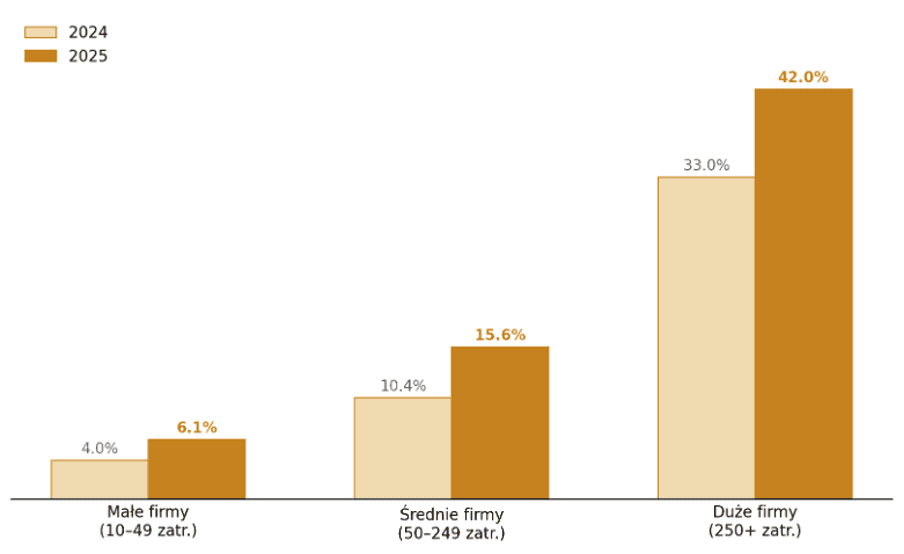
Source: ConQuest Consulting based on Statistics Poland (GUS) and Polish Economic Institute (PIE) data, 2025
Where does new competition come from and why is it growing so fast?
AI tools are now widely available, often in a simple subscription model, without the need to build your own infrastructure or hire specialists. This makes the barrier to entry into many industries significantly lower. Understanding how [the text cuts off] barriers to entry in the industry, helps to assess how real the threat from new entrants is.
New competition rarely wins through technology alone, most often combining it with operational speed
and flexibility that larger, more established companies often lack. That is why it is worth regularly monitoring market movements, and not just direct, well-known competitors. Reliable competition analysis and shows which new players are genuinely threatening the company's position and which changes are merely temporary media hype.
What from my offer will lose value, and what will gain in the AI era?
This is one of the most frequently asked questions when building a company's growth strategy in the age of AI. Services that can be reduced to a simple, repeatable process are losing value most of all: standard reports, simple translations, basic data processing, or the generation of standardized content. Since AI can perform such tasks faster and cheaper, customers stop paying extra for something that is no longer scarce. On the other hand, the value of what technology cannot easily replace is growing, namely trust built over years, customer relationships, and unique knowledge of a specific industry or market.
To answer this question in practice rather than just in theory, it is worth looking at AI Offer Resilience Compass, ConQuest Consulting's proprietary diagnostic tool. It allows you to organize a company's individual services or products according to two dimensions: task repeatability (from routine to unique, requiring a broad context) and the importance of the customer relationship (from purely transactional to deeply trust-based). The intersection of these two axes creates four areas:
Figure 1. AI Offer Resilience Compass
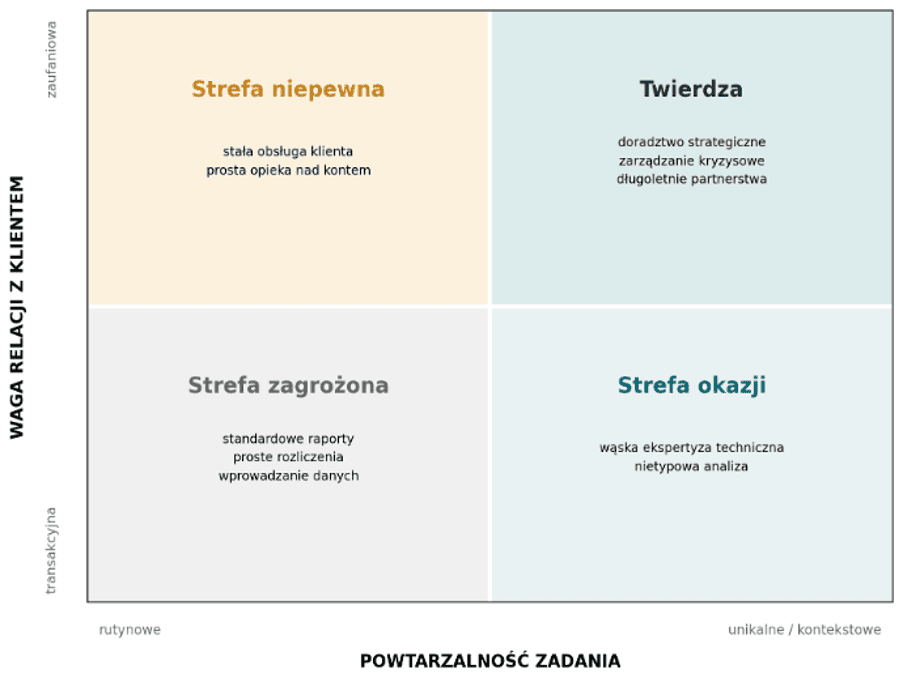
Source: ConQuest Consulting own study
- Danger zone – routine and transactional tasks, e.g., standard reports, simple settlements, data entry. This is where AI takes over work the fastest, and the client often doesn't even notice the difference.
- Uncertain zone – routine tasks, but embedded in a relationship, such as ongoing customer service or simple account management. AI will do the task itself, but the customer still expects human contact (this is where companies lose margin the fastest if they don't add any value beyond the automated system).
- Deals zone - complex tasks, but low in relational value, e.g., narrow technical expertise or unusual analysis. Difficult for AI to copy directly, but easy to lose a client to a competitor who provides the same knowledge faster or cheaper.
- Stronghold – complex and deeply relational tasks, e.g., strategic consulting, crisis management, long-term business partnerships. This is an area where advantages built over years are most resistant to automation.
Let's take an example accounting firm serving small companies. Simple invoice bookkeeping is entering the „danger zone” today because clients are increasingly using automated accounting tools. Regular, monthly service for smaller clients who expect a phone call and a deadline reminder lands in the „uncertain zone.” Tax optimization for an unusual business structure is the „opportunity zone,” which requires knowledge, but the client can also buy it elsewhere. Most valuable, however, is the role of an advisor who knows the company's history, participates in strategic decisions and action plans, and takes responsibility for recommendations; this is already the „fortress,” meaning the foundation upon which to build further long-term growth.
Quick test: place your company's three most important services on the Compass, rating each on a scale of 1 to 5 in terms of task repeatability and the importance of the customer relationship. Services that land low on both axes require urgent revision; that is where you should start the conversation about changing or developing your business model. Going through this process independently is aided by a reliable strategic consulting, which allows you to look at the business model from a distance, rather than just from the perspective of a single department.
How much will my services be worth when the market lowers prices due to automation?
Automation lowers the marginal cost of many services, and sooner or later this translates into price pressure across the entire industry. In e-commerce, experts are already explicitly warning against the risk of a price war triggered by AI assistants automatically comparing offers. Companies that compete solely on price may therefore find themselves in a difficult situation when competitors reduce costs thanks to technology, which will force them to pursue long-term development or even analyze their profitability at a critical moment.
Instead of passively waiting for margins to drop, it is worth analyzing in advance which elements of the offer truly justify a higher price and which will require restructuring. It can be helpful to rethink cost strategycompanies and a clear definition of what exactly the client is paying for beyond the execution of the service itself. Companies that base their price on real value, rather than just the cost of execution, are less susceptible to pressure caused by cheaper, automated competition.
Who to hire in the coming years for the company to grow?
According to the report of the Polish Agency for Enterprise Development the most important competencies in the labor market in 2026 are adaptability, emotional intelligence, critical thinking, digital fluency, and the ability to make ethical judgments in the context of AI usage. Market data confirms this; the number of job postings requiring AI-related skills increased between 2024
and in 2025 by as much as 86%, although in absolute terms this is still a relatively small number of listings.
At the same time, as many as one in three SMEs is struggling with a lack of digital skills, which means that the pace of market expectations is growing faster than the pace at which organizations are preparing for change. In practice, this means that it is worth investing not only in technology specialists, but above all
in employees capable of combining industry knowledge with the ability to use new tools, which will subsequently translate into business growth. People combining these two competencies most often determine whether a company actually benefits from implementing AI or merely adds another tool to its drawer.
In which direction should we develop our offer to stay ahead of industry changes?
This is one of the more important elements of the organization's development strategy in the coming years. The starting point should be to answer the question of which segments of the current offer are most resistant to automation and which will lose value the fastest. Only on this basis is it worth planning the strategic direction of development, whether it is deeper penetration of the current market or entering new customer groups with a new offer. A classic tool helping to organize these decisions is Ansoff Matrix, which allows you to look at the company's growth through the prism of product and market, and enables the creation of a tailored company development plan.
It is also worth remembering that developing an offering in the era of AI does not have to mean implementing the technology itself; equally important are long-term development strategies that anticipate how customer needs will change in a few years. Many organizations decide to strategic consulting, which helps establish development priorities as well as an action plan before the market does it for them.
Which competitive advantages are worth building because AI won't invalidate them?
Artificial intelligence is great at handling pattern-based and repetitive tasks, but it still does not replace what is built over years, which is trust, reputation, and real customer relationships. Experts emphasize outright that AI can help companies operate faster and cheaper, but it will not replace a strong, high-quality offer.
Among the advantages that are difficult to replace with technology are:
- unique data and knowledge collected over the years within the organization,
- recognizable brand and customer loyalty built on experiences,
- ability to make quick decisions and respond flexibly to changes,
- expert competencies in narrow, complex areas that are difficult to automate.
A good example of building an advantage based not only on the product, but on the entire operating model, is Zara brand strategy, which has maintained its leadership position for years thanks to its speed in responding to changes, rather than solely due to its product range. It is worth treating this as inspiration to review our own unique sources of competitive advantage before the market does it for us. In terms of the previously described AI Offer Resilience Compass, it is precisely within the „Fortress” that competitive advantages are born which no language model can invalidate.
Where to look for new markets and customers when current ones are shrinking?
If the existing market begins to shrink under the influence of technological changes, the natural direction becomes searching for new customer segments or new geographical markets. However, before a company makes such a decision, it is worth checking whether a given direction actually has potential,
and not rely solely on intuition.
In practice, this means having to answer several questions: whether the target group in the new segment truly differs in its needs, whether the new market has a similar competitive dynamic, and what regulatory or cultural barriers must be taken into account. Companies planning such a move often decide to seek support in the field of internationalization, which helps reduce the risk of making wrong decisions when entering a foreign market. Consciously expanding operations based on data rather than just the desire for growth significantly increases the chances of lasting success in the new direction.
How will customers find businesses when AI assistants replace Google?
The way customers find company offers is changing faster than you might think. According to Gartner forecastsBy 2026, the volume of queries on traditional search engines could drop by as much as 25% as users shift to generative AI assistants. According to analyses, the share of traffic generated by AI tools in e-commerce and digital marketing is expected to increase from less than 5%
in 2025 to over 50% as early as 2028.
This means that companies will need to ensure visibility not only in traditional search results, but also in answers generated by AI models. In practice, this is about publishing content that is specific and reliable enough for language models to gladly cite it as a source of answers. Building this kind of visibility is as important a task today as traditional search engine optimization, which is why it is worth verifying now whethermarketing and sales strategy companies take this direction of change into account.
How can you tell that changes in the industry are accelerating?
Some companies react to changes only when they become obvious to everyone, and that usually means the best time to react has already passed. It is therefore worth observing earlier signals. The first
the growth rate of AI adoption in a given industry is from them, if the percentage of companies using these tools is growing clearly faster year by year than before, just as it happened in Poland between 2024 and 2025, it is worth recognizing this as a warning sign.
Further signals include: a growing number of job postings requiring AI-related skills, increasingly frequent competitor announcements regarding the implementation of new technologies, and changing questions
and customer expectations during sales calls. None of these signals on their own necessarily means a revolution, but their simultaneous appearance is usually a sign that it is worth verifying the relevance of your current strategy. A helpful point of reference is the free report on the state of strategy of Polish SMEs, which shows how many companies in Poland are actually prepared for the upcoming changes. Additional context is also provided by government policy for the development of artificial intelligence in Poland until 2030, which shows the direction in which national regulations and support for companies implementing AI are heading.
How to develop and implement a company growth strategy step by step?
The starting point for any company growth strategy is a reliable diagnosis of the current situation, both within the organization and in the market in which it operates. Before a new organizational growth strategy is created, it is worth returning to the questions from the previous paragraphs: which elements of the offering are resistant to automation, where is new competition coming from, how are customer expectations changing, and how quickly can a digital transformation be carried out. On this basis, strategic goals are defined, which are specific reference points that the enterprise growth strategy is meant to lead toward – regardless of whether we are talking about the growth of a small sole proprietorship or a growth plan for a company comprising several entities. At the same time, a good growth strategy encompasses both short-term goals and a direction of action for the coming years, and an enterprise growth strategy helps choose priorities instead of reacting to everything at once.
Developing an enterprise development plan itself is only half the work. Strategic goals must be translated into a concrete strategic development plan with priorities, resources, and a schedule of actions. A well-prepared comprehensive company development plan takes into account not only the opportunities associated with AI, but also the risks described earlier: price pressure, new competition, and changing customer habits. It is worth tailoring the development strategy model to the specifics of the industry, because the development strategy of a service company looks different from the appropriate new product development strategy in a manufacturing company. Regardless of the model, the expansion strategy should provide a clear answer to the question of what the company does differently than the competition and why customers should pay for it; a good strategic plan enables such decisions to be made consciously rather than under the pressure of current events.
Even the best-prepared organizational growth strategy is useless if it gets stuck at the management board presentation stage. Implementing a growth strategy involves breaking down strategic goals into tasks for specific teams, with clearly assigned accountability and deadlines. Creating a growth strategy is merely the first step—the next is implementing the strategy into the daily work of sales, marketing, and customer service teams. The implementation of the strategy itself is often the hardest stage—this is where it is decided whether the implemented growth strategy actually changes the way the company operates or merely remains a document in a company folder. For company growth, consistency in execution is of key importance, not just the quality of the plan itself.
The last, often overlooked stage is monitoring the growth strategy – regularly checking whether the adopted priorities of the growth strategy still correspond to the market situation, which in the AI era can change in a matter of months. A good example of a growth strategy, mentioned earlier, is the approach of the Zara brand – the company regularly verifies its assumptions and quickly corrects its course, rather than sticking to a once-adopted plan. An appropriate growth strategy is not a document locked away for three years, but a living model updated as new data comes in, and long-term growth strategies that are not subject to regular reviews become outdated faster than one might think.
Regardless of the industry, building a company strategy is a process that combines diagnosis, strategic goals, and consistent action – a comprehensive development strategy covers both the offer itself and the way it is sold and communicated to the customer. That is why an increasing number of entrepreneurs treat the creation of a development strategy not as a one-time document, but as a permanent element of business management. A company development plan that takes into account the impact of AI gives the company more than just an action schedule – it provides the ability to quickly respond to changes before the competition does. This applies both to the development strategy of a sole proprietorship service business and to the market development strategy pursued by an organization planning international expansion. Many effective business development strategies combine the same elements: a clear diagnosis, specific strategic goals, and consistent implementation. Developing an effective strategy also requires time and perspective, which are often lacking in the day-to-day running of a company – which is why building a company strategy is sometimes worth entrusting to a team that looks at the business from the outside. If the development plan still only exists in the owner's head and not on paper, this is a good moment to change that by reaching for strategic consulting, which will help move from diagnosis to the implementation of the development strategy step by step.
Build a strategy that withstands AI-driven changes
The answers to the above questions are rarely the same for two different companies, even those operating in the same industry. They depend on market position, business model, existing competitive advantage, and the pace of change characteristic of a given sector. Therefore, instead of looking for universal answers, it is worth treating the above list as a starting point for your own company development strategy – and returning to it regularly, because the pace of change related to AI is still accelerating.
Companies that consciously answer these questions for themselves today gain more than just a competitive advantage – they gain time for the smooth implementation of changes, rather than acting under pressure. If you need an external perspective that will help separate real threats and opportunities related to AI from market noise, Business development strategy prepared by the advisory team, it helps to organize these decisions and indicate specific directions of action. All you need to do is schedule free consultation, to check how AI is impacting your industry and what it means for the future of your company.
Mateusz Janusz
See other entries